The Way of the Explorer
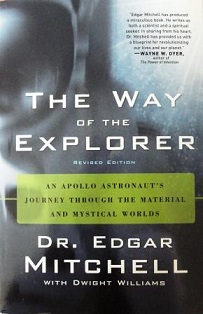
by Dr Edgar Mitchell with Dwight Williams
Subtitled: "An Apollo Astronaut's Journey Through the Material and Mystical Worlds"
New Page Books, 2008
ISBN 978-1-56414-977-0
$16.99
The Way of the Explorer
by Dr Edgar Mitchell with Dwight Williams
Subtitled: "An Apollo Astronaut's Journey Through the Material and Mystical Worlds"
New Page Books, 2008
ISBN 978-1-56414-977-0
$16.99
This book was first published over 10 years ago, and has been released once again as a revised edition. The main author is the Apollo astronaut, Dr Edgar Mitchell. He is a very well-educated individual, whose experiences in space opened his eyes to alternative possibilities beyond science. 'The Way of the Explorer' sets out to amalgamate his orthodox, scientific learning with inner, mystical vision.
The book begins as an autobiography, tracing Dr Edgar Mitchell's ascendance firstly through the ranks of cutting-edge military test pilots, and ultimately into space to the Moon. He portrays himself as a single-minded man whose goal required his entire focus, sometimes to the detriment of his family. His successful flight to the Moon must have been an incredible experience on a human level, and Dr Mitchell sketches out some of his feelings amid a fairly technical account of the flight itself. Unusually, his interest in the paranormal led him to conduct experiments in space. These experiments were then made public in a rather sensationalist fashion upon his arrival back on Earth.
On the way back towards Earth, Dr Mitchell experienced the Samadhi state. This event, rather than the Moon landing itself, seems to have been the seed which fashioned the rest of his life's focus. He is an intense individual, and he threw himself into a second exploration, this time of the inner self. The remainder of the book deals with this topic. He offers an excellent analysis of the central importance of mysticism to various religions, and views the topic from the academic viewpoint of a neutral agnostic, possibly even an atheist.
Some of the book is quite like 'The Tao of Physics'. Dr Mitchell takes the quirky aspects of quantum physics and finds parallels with Eastern Mysticism. His writing is drier than many popular science authors, and is aimed at a reader of reasonably high intellectual attainment. The central section of the book is no walk in the woods, that's for sure. But, like a climb to the top of a mountain, the book suddenly reveals a remarkable vista on arriving at Chapter 26. Dr Mitchell's central proposal is that learning and knowledge transcend individual consciousness. Instead, they are embedded within the fabric of the Universe itself, and available to consciousness through the properties of the wave/particle duality described by quantum mechanics.
Essentially, if I understand his thesis correctly, information is held in two separate states; material, and in the form of a quantum hologram. Rather like a shadowy ghost, this second form of information is separated from the material host and recombined into the matrix of the universe, finding its home in the zero-point field. It can then be accessed at a later date (and Dr Mitchell iterates that time is a one-way process) by a being of high spiritual attainment. Thus, we can learn non-locally, by tuning into spiritual frequencies within ourselves. This explains the many accounts of past-life regression, for instance, and other paranormal events where non-local information is received by a psychic. This theory is known as the 'dyadic' model, and is the main focus for the work of Dr Mitchell's Institute of Noetic Sciences.
In a way, the universe is learning about itself through the self-reflective consciousness of human beings. Dr Mitchell seems to reject the idea of a paternalistic God, and sees spiritual experience in terms of a energetic mechanism embedded into the fabric of the Universe. How to prove it? Through the study of the paranormal, preferably under scientifically valid conditions, argues Dr Mitchell. He has much experience of this himself, through his own experiments in space, and through the association with and study of psychics like Uri Geller.
I'll quote here a couple of passages from the book which deal with topics of interest to regular readers of this website.
Firstly, on Roswell:
"I recall that when I was a teenager, an alien spacecraft was announced to have crashed near our ranch in Roswell. A flurry of speculation and gossip followed in its wake, until the next day, when the official explanation was amended and the government cited the incident as having been a fallen weather balloon. Was it? More recent events and disclosures reveal the weather balloon explanation to have been silly and deliberately misleading. These events were in part what made the times so unbearably exciting." (p31)
Secondly, on Zecharia Sitchin:
"A radically different explanation for the one-God concept is found in the writings of Zecharia Sitchin, a Sumerian scholar [sic]. Though largely ignored by other Middle Eastern scholars, Sitchin's translations suggest that the account in Genesis of creation is an abbreviated version of tablets unearthed in Sumer and Chaldea. These tablets record a more complete story, which includes planetary configurations not known until this century, the details of which were only confirmed by spacecraft flybys of the planets during the last 25 years.
"If valid, it's an astounding bit of news. Science requires that a theory make successful predictions, and the Sumerians may have done just that long before we had a means to confirm them. Unfortunately, Sitchin's translation suggests extraterrestrial presence in the prehistoric period as the source of planetary knowledge and the one-God concept - a totally unthinkable idea a few decades past, but not necessarily today if the translations are correct." (pp165-6)
There is a great deal of wisdom in this book. It reminds me more of a Buddhist Wisdom book than a popular science book. Like Buddhist teachings, it is difficult to follow, and is fundamentally deep. But, ultimately, the book is rewarding. Towards the end, particularly in the revised section, the book rambles and repeats itself whilst trying to focus on the issues of the day. It doesn't seem so necessary to me to try to find a sense of urgency for this material. It stands on its own two feet, one particle, one quantum hologram. For me, personally, it serves to point a way for an agnostic like me to seek inner wisdom in the Universe, and to see the bigger picture in the absence of a tangible presence of God.
So, thanks, Dr Mitchell, for a wonderfully enlightened book. I include a few quotes from the book below, which will serve to give the reader a feel for the astronaut's writing style.
 You can order your copy through Amazon.com here:
 If you live in the UK, you can obtain your copy through Amazon.co.uk here:
Book review by Andy Lloyd, 8th April 2008
Books for review can be sent to Andy Lloyd at the author/publisher's own risk.
Dr Mitchell Acknowledges that Aliens Have Visited Earth
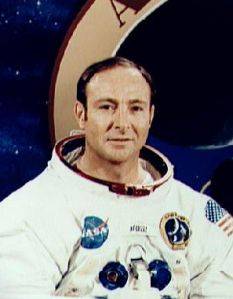
NASA continues to claim that there is no cover-up of alien
visitation on Earth. The full transcript of the interview is set out
below.
Reference:
The Daily Mail, "Apollo 14 astronaut claims aliens HAVE made contact - but it has been covered up for 60 years" 24th July 2008
Nick Margerrison: Do you believe in life on other planets?
Dr Edgar Mitchell: Oh yes there's not much question at all but there's life throughout
the universe, we're not alone in the universe at all.
N – You're convinced that we're not alone in the Universe?
EM- Oh I know for sure that we're not alone in the Universe. Now have we been
able to identify for sure where the other planets are? No we have not. Certainly
not in our Solar System. But they've identified quite a number of other planets
now that very likely could be life
bearing planets. And I've been very privileged enough to be in on the fact that
we have been visited on this planet and the UFO phenomenon is real although it's
been covered up by governments for quite a long time.
N - Woah. Hang on a minute this is big. Woah all this is quite a shock to me.
EM – Well I'm sorry have you not been reading the papers recently, its starting
to open up quite a bit.
N – Well this is a lot of information to take on board. I've heard crazy UFO
nuts tell me this kind of thing before, I've never had
Dr Ed Mitchell – the sixth man to walk on the moon - a respected scientist in
his own right announce to me that we've been visited by
aliens from other planets and they're definitely out there – there's no debating
it?
EM – Well you should have talked to me and I would have told you about it before.
N – So you believe the whole deal
EM – There's more nonsense out there about this than real knowledge – but it is
a real phenomenon and there's quite a few of us – its been well covered up by
all of our governments for the last 60 years or so but slowly its leaked out and
some of us have been privileged to have been briefed on some of it. I happen to
have grown up in Roswell in New Mexico where presumably the Roswell incident of
1947 took place and I'm quite knowledgeable about there since I grew up there
but I've also been in military circles and intelligence circles that knows
beneath the circles of what has been public knowledge that – yes we have been
visited.
N - Are you been serious? You're not just going to go I was pulling your leg
there it's not true? I was wondering if I had stumbled upon
Astronaut humour and in a couple of minutes you're going to go I was pulling
your leg
EM – No I won't say that.
N – Wow. So you've been briefed on the fact that we've been visited?
EM – Well briefed is one word for it. I have been involved in much of this work
– now its not my main work, its not my main interest but I have been deeply
involved in certain committees and certain research programmes with very
credible scientists and intelligence people that do know the real inside story
and I am not hesitant to talk about it.
N – What is the real inside story?
EM – Well I've just been telling you, we have been visited.
N – So are we in regular contact or was it a one off crash?
EM – There's quite a bit of contact going on. I can't tell you because I don't
know all the inside details because that isn't my main interest but the fact is
that we have been visited, the Roswell crash was real and a number of other
contacts have been real and
ongoing. It's pretty well known to those of us who has been briefed and been
close to the subject matter.
N – So why is it being covered up then? Why is it not mainstream?
EM – The reason for that goes back to the main incidents that started taking
place after World War Two when in the United States at least -I can't speak for
the European governments or the South American governments – all of whom have
recently started opening their files and this is starting to open up. Look at
the internet or some of the International press and you start to get the stories
coming out now.
N – I've had people on the show telling me the governments are mounting up
towards disclosure towards saying that this is the case.
Do you think there will be an actual disclosure this year?
EM – I don't know whether it will be this year in the United States. But
certainly we've already had it in the last few years from the
Belgian government, the French government, the Brazilian government, the Mexican
government. They've opened their files and admittedly had the files.
N – Do you think we're ramping up to the UK admitting?
EM – Well I can't say how fast it's going to happen but certainly the public awareness is increasing, the public acceptance is increasing. The attempts to cover up seem to be decreasing, I think we're heading toward real disclosure and there are some very serious organisations moving in that direction.
N – What do you think the impact will be on the world when it is finally
mainstream news that there are alien beings that live outside
this planet?
EM – Certainly in the United States well over 70% of the people now accept this
as fact. They do not know all the correct story but they
accept the fact that there's visitation. There are UFO's in the sky all the time
which are very likely to be alien craft. Now not all of
them are – I suspect some of them are home-grown. I suspect that in the last 60
years or so there has been some back-engineering and the creation of this type
of equipment that is not nearly as sophisticated – yet – as what the apparent
visitors have
N – As part of you knowing about this and also going public with this, are you
worried with your safety?
EM – I think those days are gone. That used to be a concern among the people on
the inside but I don't think they're knocking anybody off for that anymore, or
doing drastic things to them
N – What do you think the intent of the aliens is? Is it hostile or peaceful?
EM – It's not hostile. It's pretty obvious that if it were hostile we'd have
been gone by now.
N - Really?
EM – We could have been. We had no defence if that's what their real intent was
.
N - What do they look like?
EM – You've seen some of the pictures. The pictures that I know of are little
people that look strange to us as far as I know from my
contacts that have had contact – that looks pretty accurate,
N - Do you think other people that were involved in the moon landings know about
this?
EM – Some of them do but again it's like other people, If you're interested
enough to dig into it and want to know about it – you can
know about it.
N – This has been easily one of the most significant conversations of my life,
unbelievable. I want to thank you for joining us, wow what
an incredible conversation
EM – I'm glad you enjoyed it.

Book Review Listings by Author and Title
Book Review Listings by Subject